Tuesday, May 15, 2007

Whole Wheat Cinnamon Rhubarb Muffins

I wrote about these on my main blog also: HERE)
I make most everything with stevia, so I will give you my version of these muffins.

Wet Mix:
1/2 C smooth applesauce
1 1/2 C soymilk
3 Tbsp light tasting olive oil
1 T lemon juice
2 tsp vanilla
1/2 tsp Ener-G egg replacer
1 1/2 tsp KAL brand stevia

Dry Mix:
2 1/2 cup whole wheat pastry flour
1 tsp baking powder
1 tsp baking soda
1/2 tsp salt

Additional:
1 1/2 cup diced rhubarb, can be frozen (mine wasn't)

Preheat the oven to 400 degrees F. Prepare muffin cups by greasing or spraying with pan spray (I use special unbleached parchment papers because I like low fat baking and do not want the muffins to stick to the paper and rip apart). Combine the wet mix in the blender or food processor. In a medium bowl combine the dry mix. Add the wet to the dry and stir briefly just to mix. Spoon evenly into the prepared muffin cups. Bake for 20 - 25 minutes. C Cool the pans on racks for 5 minutes, then carefully loosen the muffins with a table knife and turn them on their sides to cool a bit more before serving. These vegan muffins are quite tender when they are very hot, but they firm up with cooling.

Bryanna makes 18 muffins with this recipe, I made 11. I made a decorated tiramisu type muffin using Dreena's agar frosting, fresh strawberries, and a heart shaped candy. They were a pretty presentation to the end of our meal and for breakfast the next morning.

Monday, February 05, 2007

Dori's COOP Black Bean Soup

I have mentioned before that I live a one hour drive to anywhere, except a local buying club where I get many of my organic, allergy friendly, and unique international food finds. We have no store front, just a monthly gathering place where a semi stops and we unload the truck and divide the orders. My buying club is well organized by a few dedicated members who started it many years ago. When I first thinking about starting the bakehouse, I did some research and found information about a gal who started a bread and soup business from her barn (of course they renovated it and made it into a commercial kitchen) so she could sell at the local organic food COOP. At the time I read about this business was going very well for her, so I called her and asked if I come come see her operation because I was in process of doing something similar.

One thing I gained from this experience is a black bean soup recipe. The first soup I ever made from black beans early in my new veg experience. I loved it and today I share it with you. I call it mine because I made it.... because it's my blog.

THE RECIPE:

2 cups uncooled black beans, wash, soak 6 - 8 hours, rinse.
Add enough water to cover beans in a large dutch oven.
Cook 1 - 2 hours with 2 bay leaves and 1 Tbsp salt.
Puree 1/2 the beans (blender or hand held mixer) and return to pot.
In a small skillet saute 1 cup onions, 4 cloves garlic (minced), 2 cups celery (chopped), 1 cup carrots (diced), 1/2 tsp cumin, 1 tsp dried basil, and 1/4 tsp celery seed.
Cook 10 minutes until veggies are softened and add to pot with the beans.
Add 1/4 cup fresh parsley, 2 1/2 Tbsp lemon juice and 2 cups water.
Cook another 30 minutes. Serve with sour cream if desired.

Total recipe 998 calories. Serves 6 at approximately 1 cup each = 167 calories.
This is a ww core recipe.

Link to Bakehouse Blog...
Black Bean Soup De-gassed
Learn about the herb epazote

Tuesday, January 16, 2007

Golden Cauliflower Soup

Golden Cauliflower Soup

Comforting in color and texture to a cheesy soup.

Add all to a 4 quart crockpot and cook on high 6-8 hours or low 8 – 10.

½ C besan flour (Indian chickpea flour)

½ C red split lentils

½ C Red Star nutritional yeast flakes

¼ C bac’un bits

1 C finely minced onion

1 large clove of garlic minced (1 - 2 tsp)

1 C diced carrots

1 C diced celery

2 C cauliflower flowers

¼ C dry parsley flakes

1 tsp sea salt

1/3 tsp paprika

½ tsp dry ground mustard

2 tsp Penzey’s shallot pepper

2 tsp Bill’s Best chik’n seasoning

2 Tbsp Lemon juice

1 Tbsp tamari (soy sauce)

3 Tbsp deep red/brown miso (mixed with some water so that it dissolves into the soup)

NOTES:

Made 1-15-07 in the crockpot. Added frozen thawed cauliflower to cook for the last two hours. The family enjoyed this meal. I would like to work on the flavoring …. Just a little. I did add Nature’s seasoning to mine and then liked it well enough.

Monday, August 28, 2006

Tart for T' Art Recipes

You have now been offically sworn in to noble vegan status. With this honor you will uphold the sacred details and be willing to defend all types of vegan t'ART's . Go forth now into your kitchen and cook.
RUSTIC ITALIAN STYLE PUMPKIN
Fear not. Pictures appear on my main blog page THE BAKEHOUSE (click to link)

SPELT PASTRY CRUST
(double this recipe for the large tart like I made)
1 Cup plus 1 Tbsp spelt flour
3/4 tsp sea salt
2 Tbsp extra-virgin olive oil
1/3 Cup ice cold water
Combine the spelt flour and salt, cut in olive oil with a fork. Add the ice water... gently mix until a ball forms (do not over mix or knead). Let sit for 5 - 10 minutes. Roll out to 1/4" thick between two 14" x 12 " peices of unbleached parchiment paper. Remove one side of thepaper, place uncovered side of crust in a 14" round dish tart pan (or pizza sheet) and remove the back paper.

TART FILLING (1/2 this recipe if you make a single tart crust recipe):
Steam about 4 cups of diced pumpkin (discard skin and stringy innards, but keep seeds if you desire to roast them) or use a microwave veggie cooker using the 2nd potato quick cook setting (about 6 minutes). On the stove top saute onions and 3 Tbsp garlic in 1 Tbsp olive oil until softened and lightly browned. Add the cooked pumpkin and shredded chard leaves (about 6 cups) with 6 Tbsp parmesan alternative (recipe below) , 2 Tbsp cider vinegar, and 1/2 tsp sea salt. Cook until chard wilts, no need to cook longer because they will finish cooking in the oven.

BRYANNA’S WALNUT PARMESAN ALTERNATIVE
Makes about 1 and 1/2 c.
(wheat-free and can be soy-free)
If you have a soy allergy, or you have a hard time locating Galaxy/Soyco’s delicious Soymage vegan soy parmesan substitute, this is an easy and tasty alternative, either as a topping, or particularly as an ingredient in certain recipes. This is just about the right amount to fit into two of those little shaker bottles, but you can easily double, triple or quadruple the recipe and keep it refrigerated or frozen. It was inspired by the commercial product called “Parma” and is a variation on my "Almonzano" recipe from "Nonna's Italian Kitchen".
Use a food processor or mini-chopper or spice mill for this recipe, rather than a blender.
1 c. chopped raw walnuts
4 T. nutritional yeast flakes
2tsp. light soy or chickpea miso
1/2 tsp. salt
Process the ingredients until as fine as possible. Stir to get rid of any lumps. Place in a covered container or shaker and keep refrigerated.

Tart Assembly:
Pre-heat oven to 375 degrees. Place filling in center of tart crust leaving 3" edge and bring up the edge around the filling to make a free form style pie, pleat the edges over the filling to make it pretty and a nice round center of open filling shows. Cover the open filling with foil. Bake tart for 45 minutes (if doubling the crust recipe and using the amount of filling I list here). 30 minutes if using a single crust recipe and halving the filling recipe. Cut into wedges and serve with a favorite white bean/ garlicy OR a good Italian style tomato soup.

Friday, August 11, 2006

STRAWBERRY LEMON CRUNCH CAKE

Pictures of this cake and other information will be found on my main blog.
Click here to get there.

BRYANNA’S STRAWBERRY LEMON CRUNCH CAKE
Serves 8-12
This was one of the first vegan cakes I made, but I’ve modified it further. It’s a lovely presentation.
The Lemon Genoise Cake:
DRY INGREDIENTS:
2 c. plus 2 T. white unbleached pastry or cake flour
1/2 c. ground lightly-toasted blanched almonds
1 and 1/2 c. light or white granulated vegan sugar
4 tsp. baking powder
3/4 tsp. salt
WET INGREDIENTS:
1/4 c. plus 2 T. Earth Balance
1 c. water
3/4 c. soy or rice milk
2 T. fresh lemon juice
1/2 T. vanilla
grated zest of one organic lemon

The Lemon Crème Frosting:

3/4 c. nondairy milk
¼ c. fresh lemon juice
6 T. white unbleached flour
6 T. Margarine Earth Balance OR non-hydrogenated shortening (Spectrum) OR solid coconut oil OR a combination
1 c. white or very light granulated vegan sugar
grated zest of one organic lemon
1/4 tsp. vanilla extract
1/8 tsp. salt
The Garnish:
2 c. lightly-toasted sliced almonds
4 c. fresh strawberries, cleaned, hulled, patted dry and halved lengthwise (try to use berries that are of similar size, if you can)

To make the cake:

Preheat oven to 350 degrees F.
Mix the dry ingredients together with a whisk in a large mixing bowl. Add the margarine and the water and beat with an electric mixer for a minute. Add the remaining ingredients and beat one more minute. Divide equally between two 9" greased and floured round cake pans lined with cooking parchment. Bake 25 minutes, or until cakes test done. Cool on racks for 5 minutes, then loosen cakes and remove from pans to finish cooling (remove parchment).

To make the Frosting:
Whisk milk, lemon juice into flour in small saucepan until smooth. Heat and stir until it boils and thickens. Cool thoroughly (place in a small bowl inside of a larger bowl of cold water).
With an electric mixer beat the margarine, shortening or coconut oil, sugar, vanilla, lemon zest, and salt until light and fluffy—- several minutes. Beat in the cooled flour paste with the electric beaters and mix until smooth and fluffy. IMPORTANT! Chill thoroughly before frosting. Use to frost any cooled cake. IMPORTANT! Keep the frosted cake refrigerated until serving time.

To assemble the cake:

Place one cooled cake layer on a serving plate. Spread evenly with some of the frosting. Place the other layer on top. Swirl the frosting on the top and sides of the cake. Pat the toasted sliced almonds all around the sides and just over the top edge so that they stick to the frosting . Overlap the strawberries in an artistic design, cut side down, on the top of the cake. Chill before serving.

Saturday, July 29, 2006

Blogroll

Please note my blog roll is now on the side bar of this page. I have been
enjoying the free service of bloglines because now I get alerted when the
people on my blogroll update their blog page.
Check them out at http://www.bloglines.com/

Tuesday, June 13, 2006

Grilled Tofu

These are from Bryanna's free Vgean Feast Recipe Archives.  See sidelink for direction to her site.


BRYANNA’S TERIYAKI TOFU BURGERS    

Makes about 8 "burgers"

From my book “Soyfoods Cooking for a Positive Menopause”.


Serve these like a "cutlets", or burgers on sesame buns, or slice them up and eat in a wheat tortilla, or add to a stir-fry.


 24 oz. firm tofu, sliced 1/4" thick


Teriyaki Marinade:

1/2 c. EACH soy sauce and water

1/4 c. dry sherry or white wine (or apple, pineapple or white grape juice)

1/3 c. maple syrup or unbleached sugar

1 tsp. grated fresh ginger (or 1/4 tsp. powdered)

1 clove garlic, crushed


Mix together the marinade ingredients in a small pot and simmer for a few minutes over high heat.  Pour the sauce over the tofu slices in a covered container, covering the slices with the sauce.  Cover and refrigerate for up to a week.  Grill or broil the slices, or pan-fry in a nonstick skillet over medium-high heat until browned on both sides.


BRYANNA’S BEST-EVER TOFU “BURGERS”    

Makes 6 large “burgers”

From my first book, “The Almost No-Fat Cookbook”.


This “burger” has the chewy texture and juiciness associated with a truly good burger.  In this recipe, frozen tofu provides the chewiness, and the dark marinade lends a "meaty" flavor and moist juices.  It’s not really a “burger”, since it consists of a slab of marinated tofu, but no matter—it’s good!


2 lbs. medium-firm or firm tofu, frozen at least 48 hours


Marinade:

1 and 1/2 c. water

2 T. soy sauce (regular or mushroom )

2 T. ketchup

2 tsp. Marmite, Vegemite or other yeast extract, (gives a “beefy” flavor)

     OR 4 tsp. red or dark miso

OPTIONAL: 1/2-1 tsp. liquid smoke

1/4 tsp. garlic granules

1/4 tsp. dried oregano

1/4 tsp. dried basil

1/4 tsp. onion powder

OPTIONAL: gravy browner (for color—or use dark or mushroom soy sauce instead of regular soy sauce –see above)


Thaw out the tofu.  Slice each pound block into three thick slices.  Place the slices on a cookie sheet covered with a couple of clean, folded tea towels.  Cover the slices with more tea towels and another cookie sheet.  Weigh this arrangement down with something heavy for about 15-20 minutes.  Now the tofu slices are ready for marinating.


Mix the marinade ingredients together and pour over the prepared tofu slices in a shallow container in one layer.  Cover and let marinate for several hours or days.


Just before serving, pan-fry on a lightly-oiled heavy skillet or nonstick skillet over medium-high heat until browned on both sides.   Or cook on an indoor grill.  Serve on buns with all the trimmings.

Saturday, May 20, 2006

Taco Lentils


Saute:
1 C minced onion
1 clove garlic
1 tsp olive oil
Add and bring to a boil:
1 cup dry lentils
1 tsp ground cumin
1 Tbsp chili powder
1 tsp oregano
2 1/2 tsp chik'n broth powder (Frontier)
2 1/2 C water
1 cup salsa
Reduce temperature, cover and cook 30 minutes, until lentils are tender. Uncover and cook for 6-8 minutes or until mix is thickened. Mash lentils slightly.
Serve on taco shells with lettuce, cheese of choice, black olives, whatever you like.

Dry Potato Soup Mixes

I have made these dry soup mixes, packaged them in a pretty bag and sold them at my booth. I also enjoy keeping them on hand for when I needed the kids to do a fast meal for me. Making my own is economical and since the mix is complete (add more veggies if you want) and just add water, they travel easy. All that is needed is microwave boiling water or a crock pot... especially nice for hotel trips. I have many other varieties of dry soup mixes I have enjoyed over the years.... this is a start, perhaps one day I will make a special page of these recipes compiled into a collection for my blog reader enjoyment.

MUSHROOM TATER SOUP MIX
2 C instant potato flakes
1 C TVP granules
1/2 C chopped dried mushrooms
1 C chicken style broth powder (I use Bryanna's homemade version or Bill's Best)
1 C dried soup vegetables (I get these in bulk from Frontier coop)
3 Tbsp bacon like bits
1/2 tsp pepper
1 tsp garlic granules
sea salt to taste (broth mixes vary greatly in their salt content)
Mix together. Store in a jar and when ready to make use 1/2 C mix per 1 cup boiling water... cover and allow to sit 15 minutes until veggies are softened. Place 1 C mix (2 servings) in a bag, label and decorate nicely and sell for $1.50.

SCALLOPED POTATO SOUP
This one is more of a family meal instead of individual serving and makes 6 cups.
2 cups dehydrated potato slices, slightly broken up
1/3 C white bean flour or besan (Indian chickpea flour) which cooks up faster
2 Tbsp or more mashed potato flakes depending on thickness of soup desired
2 Tbsp dehydrated onion flakes
1/4 C nutritional yeast
approx 1 1/2 tsp sea salt
1 Tbsp celery flakes
1 Tbsp red pepper flakes
1 Tbsp vegan chicken style broth powder (Frontier)
2 Tbsp bacon style bits
Place 6 Cups water into a pan, bring to a boil, add soup mix. Simmer 30 minutes until potatoes are tender. Stir occasionally. Can also cook in crock pot on low, all day if you like. Stir, serve ... yum!

Wednesday, May 10, 2006

The Bakehouse Tour

Here it is! I would like to welcome you into our little commercially zoned house turned baking/ growing/ storing house for the Harvey Family and all their little projects. Now before you begin this tour you need to know that what you see here is not what we see here. We see what will be in ten years, just as we saw what you see now five years ago. We have stretched, sweated, went without, prayed for, cried with and a time or two even shed blood to be able to show you this and more of all that will probably continue as we progress with this Dave & Dori brain child. This is paid for, it is ours, and we thank God for all he has blessed us with... skills, hardware, family, friends, and vision.

The Bakehouse is a place that I have made a variety of whole organic grain vegan baked goods including 6 flavors of high soy protein granola, yeasted wheat breads, cookies, and muffins. We have also assembled dried packaged soups and made organic jellies and mustards. This business started as a homeschool project and has been a very busy place (including all the work we did to it and in it) for the last four years. This summer the bakehouse will be quiet during market season since I will be taking the last of the classes I need before student teaching this fall. My son also "leaves the nest" (home on weekends) this fall as he begins a computer networking and technology program. BUT, stay tuned for what will come next ...

Picture 1: The Bakehouse (left)
The ramp on the south side of the house was built so that my wheel chair bound grandma and a family friend could come and visit.

Picture 2: The Kitchen South (right)
Upon entering the kitchen door you will see the sink/ counter and two BOSCH Universal on the left. Above the mixers I have a strip of wood with 7 clothes pins attached to it. It holds the recipe cards and the summer baking schedule, the little shelf holds some ingredients that are commonly used in a handy location.
Picture 3: The Kitchen North (left)
On the right side of the room we placed a tall table, the right height for standing while working. Under it we have stainless steel storage bins. The "tall" tabletop came from a school auction for $1 (we adjusted the leg height with steel piping) and the bins came from a hardware store that closed near us, we got 24 of them for $5. The red rack was a gift from a neighbor. The household oven you see in the background was purchased for $20 at an auction... we had it tested by a professional and it works good as new.

Picture 4 (right) and 5 (left): The pan rack
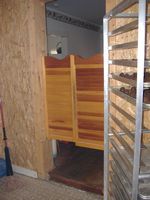
The pan rack is wonderful to hold many items on the commercial oven sheets. I can make 12 - 1.5 lb loaves of bread or 2o - 1 lb round loaves using the two BOSCH Univesal mixers and in one baking. I make 30 lb's of granola on 8 pan sheets (2 baking cycles) and 8 dozen cookies on 4 sheets to bake all at one time. There are saloon style swinging doors hiding behind the pan rack that were purchased at an auction several years before we purchased the bakehouse. I always thought a kitchen with those doors would be the ultimate, Dave widened the doorway to make it perfect for the doors so now I have the ultimate!

After buying the house we had to re-pipe for city gas connection, replace water pipes, redo the entire electrical wiring and allow for a much higher voltage ability to allow for the commercial oven (plus be inspected to meet all city codes and regulations) and replace the roof (rebuilding it in some sections after taking off four layers of roofing). This has truly been a family baby!! We have worked together with our children and many friends to see what we have done here happen.


Picture 6 (left) and 7 (right): The oven room
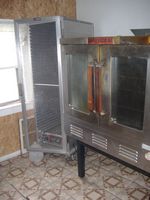
This room is off of the kitchen. It was once used as a kitchen storage pantry. We widened a doorway and had to run a ventilation system in the ceiling above the commerical oven to meet the requirements of the fire marshall. Beside the full size 4 rack commercial convection oven (each rack holds as much as a standard household oven) is a proofer. I set the temperature and humidity of the proofer to create the ideal bread rising environment. I just put the bread on the oven sheets, place them in the proofer, shut the door and on my regular market breads 30 minutes later they are ready to go into the oven. I have six timers on the side of the oven as you see one in the cooling rack picture. Last year during mid summer markets, my cooling racks on baking day are completely full of goods to cool, bag, label and sell. Many weeks our family gets the one loaf that Dave tucks away from my market table, otherwise I sell it all. We do not air condition when I bake, and the use of the fan when placed in the window helps keep the air moving and cooling takes place well. The bread MUST BE completely cool before being placed in a bag. On the cooling rack I also have stackable smaller cooling rack for when I do cookies.

To bring the oven in Dave ripped out two walls and an exterior house door which we had plans to replace anyways. It took six men to get it placed. It was not a small task! I think if we ever want to take it out of the bakehouse it will go out in parts. In the three years I have baked from this I have not had a problem. We bought the oven used. It came out of a senior citizen housing complex and was replaced because government funding required different equipment.
Picture 7 (left) & 8 (right): Canning Closet and Freezer Room
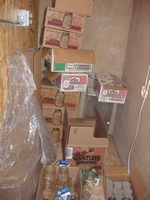
A closet is dedicated to storing cannnig jars and a freezer room holds two large freezers and a refrigerator. In this same room we have a "shipping table" (another find from the hardware store that went out of business). It holds bags that I use for various products, seven sizes ordered in quantities of 1000 bags each time I need to order. I get 10x16 bags for bread, 4x16 bags for 12 oz granola, 4x6 bags for three cookies, 4x10 for soup mixes, 5 lb granola shipping bags, and 15 lg granola bags, etc.

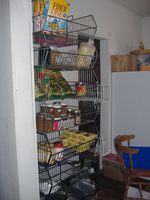
The food storage rack is handy, it is the same racks that are under the tall table in the kitchen (from hardware store going out of business). I have a stack like this in the basement of our house also to store home canned goods on. Our storage racks are unique, but many cheap storage solutions can be made ... when there is a will there is a way! An upright freezer can be seen behind the racks. A large chest freezer is the place I store bulk grains and other products that are perishable for business baking. I have a smaller cehst freezer at my house for personal family storage. All these items were used, the chest freezer came from a grocery store that was remodeling and the refrigerator came from a household auction. I could tell many ways in which our dollars were stretched and we received awesome bargains during the process of getting the bakehouse to this point. We don't believe we are lucky, but we thank God for the many times He has answered our prayers peice by peice.

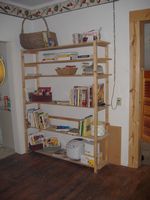
Picture 9 (right) The "store" room At one time we thought we wanted to open a little store and share the bulked goods that we purchased for our family so we set up the main room with shelves and wooden bins. We realized this was not a good match for us and never changed our name for this room. We now use the room as an office/ study/ sometimes guest room (there is a couch on the other side of the room). One 4 foot wide 7 foot tall shelf now holds a few small kitchen appliances and books on a variety of food subjects and health concerns/ diets. Dave built two of these shelves and two smaller shelves to hold our products at the places they sell locally.

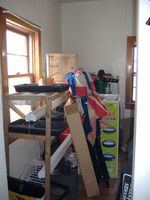
Picture 10 (left) The plant nursery and storage room. The shelf here was built with flourescent grow bulbs to start plants from seed (peppers, broccoli, cauliflour, cabbage) because our growing season is not long enough to plant the seed into the ground. This year I did not start my own seeds, so you see my market canope resting up against the shelf to rest until we are ready again next year. We have a 20'x30' greenhouse frame that we plan to put up next year also (after we solve the issue with how and where to have the water valve). The green house is a part of the future vision that we see. The other side of the room holds a huge storage rack for garden equipment and market tables / containers/ baskets.

Personal afternote on the future: This year the bakehouse will not be emitting it's sweet yeasty smells each week since I am getting my teaching certification and will be in classes this summer. When I complete this I intend to replace our home school support teacher (she is retiring) and carry on with the vision Dave and I have for our investment property. Part of my vision is to help families who want to take a step into the gardening and whole grain, organic cooking to learn how to using my blessings. I have hosted homeschool outings and many friends from our church who desired to learn. I believe the best way to teach is to provide the play area and offer direction. If you consider the cost of 1 lb of fresh or canned organic produce, a quart of organic soymilk (or almond or rice milk), and a loaf of whole grain organic bread... being a do-it yourselfer allows me to get all three items each day to feed a large family of four for less than 30 cents a person. Of course I had initial expenses in equipment and garden preparation... when we got our garden area it was filled with 6 foot tall weeds, we had to hire a tractor to mow it down. When a person has a desire... all things are possible! Stick to it, learn with each new step, but if you never start you can never accomplish anything.

Friday, April 28, 2006

FOOD ALLERGIES 101

OVERCOMING FOOD ALLERGY

I researched this topic and wrote the following while trying to understand, feed, and live with a son who has multiple food allergies to many common foods. I also have food allergy issues in a smaller way. I hope you are helped by the information found here. Please comment below to let me know you stopped in.

By Dori Harvey, BA
It is estimated that true IgE related food allergies are rare and that only 8 - 10 % of the population suffer them. This number appears to be growing as more patients with digestive difficulties see their doctor for relief. New understanding into the bodies allergy process can offer new treatment methods that result in a great reduction to the number of IgE related foods in a patient with multiple food allergies and relief from the allergic response in others. Most food allergies are not fixed and the development of new food allergies can be stopped! This paper will offer basic allergy understanding and then focus on the dietary treatment prescribed to help many suffering from food allergies overcome them.

ALLERGY 101 :

WHAT IS AN ALLERGY?
Allergy (2): exaggerated or pathological reaction (as by sneezing, respiratory embarrassment, itching, or skin rashes) to substances, situations, or physical states that are without comparable effect on the average individual Merriam-Webster Medical Dictionary, © 2002 Merriam-Webster, Inc.
All allergic responses in humans take place after histamine is released into the body. Histamine is a chemical produced by the body . It’s job is to yell "HELP!" to the immune system which can release the IgE antibodies (the army) to fight off substances that can harm us. This is for our own good most of the time, but is a problem when the body begins to fight things that will not harm us, such as food or even our own working body parts as is the case in many the 128 auto-immune diseases, such as fibromyalgia, commonly diagnosed today. The way the "army" goes to work on a bad cold bacterium is the same as the allergic response with a good food protein, when the protein histamine is released we experience a wide variety of symptoms ranging from excess mucous, eye irritation or even sometimes an asthmatic reaction as the lungs try to block off the passageways in which foreign matter gets in.

An allergy is considered a problem because our body is at war with many things that usually do not affect humans or are considered harmless. (Much could be speculated about the harmless chemicals in the air we breathe, the synthetic carpet we walk on, or the laboratory made orange juice cocktail we drink, but this is beyond this essay’s scope.) When the immune system army is constantly at work we experience the irritating and sometimes life threatening side effects that can stop us from living productive lives, so we try to correct the symptoms by taking medication. Allergy medications are called anti-histamines and their purpose is to stop the histamine from alerting the immune system to respond. Although helpful at the moment because it can stop or help lessen the IgE mediated allergy symptoms, we can speculate the long term use of this remedy especially when a harmful cold bacteria comes in and our cells are not allowed to cry for help. This realization may lead us looking for other solutions, possibly ones leading to a real correction of the problem.

AN ALLERGY TO FOOD?
While many people experience food intolerance or sensitivities, this is not the same as an immune system response type of allergy. Usually a person diagnosed with a classic food allergy has allergies to other things such as inhalants, dust, molds, etc. and often has a first generation relative with allergies. A classic food allergy involves the protein in a food as it is released into the blood stream via the intestinal walls. The immune system sends out IgE antibodies that attack the protein in the same way that the IgE antibodies would attack a dust, mold, or "cold" bacteria protein. Some people seem to be born with an allergy and know very early in life while in other allergic reactions seem to come and go or develop/ worsen with age. With all this unpredictability it is hard to know what is a true allergy! Understanding that the body acts the same way with any allergen gives us an idea of why this is so.

Consider that our body is like a bucket that can only hold a certain amount of water before some begins to spill out if we keep adding to it. (1) It doesn’t matter what we are reacting to (food proteins, air fumes, chemicals in detergent, etc) , when the histamine response occurs the kind and type of reaction will vary depending on the amount and location that the histamine is released. This can make it nearly impossible to single out which foods may be triggering the histamine response creating a spillover of symptoms.

MEDICAL CONDITIONS ASSOCIATED (caused or aggravated by) WITH FOOD ALLERGIES (2):
RESPIRATORY:
hayfever, asthma, bronchitis, recurring ear infection, sinus conditions, rhinitis, laryngitis, allergic sore throat, hoarseness
DIGESTIVE:
gastroenteritis, irritable bowel syndrome, celiac disease, inflammatory bowel disease, diarrhea, constipation, colic, malabsorption
CEREBRAL:
headache, dizziness, sleep disorders, learning disorders, tension fatigue syndrome, foggy thinking, irritability, depression
SKIN - RELATED:
dermatitis, eczema, angioedema, hives, rashes
RELATED TO OTHER BODY SYSTEMS:
arthritis, myalgia, urinary irritation, conjunctivitis, edema, hypoglycemia, diabetes, overweight, underweight, premenstrual syndrome, fatigue

Food allergy testing can assist with finding out what food may be helping to trigger the allergy responses as you travel toward the destination of good health. There are several methods of food testing available. The method you choose may be dependant upon the type of professional you see to help you in your search for good health. The range of doctorate level professionals specializing in helping others regain good health come from disciplines such as nutrition, orthopedics (chiropractors) who often take further study in naturalopathic remedies but may offer "new age" testing and treatments , doctors of medicine (commonly paid by most major insurance companies and offer laboratory drugs to relieve symptoms), and metaphysical doctors who may do "new age" muscle strength testing using food synthetics held in a glass vial in combination with aurora sensing. Just as the kind of help each professional offers may vary, the reliability of each type of testing varies greatly. Skin tests are often not recommended for food allergies because the allergic response may be severe. Since our definition of classic food allergy requires IgE antibodies to be present, only blood testing can be considered the most reliable test for diagnosis.

There are many varieties antibody level blood tests in which hundreds of foods can be tested using one blood sample. The RAST (radio-allergo-sorbent test) blood test involves mixing 96 differing food proteins with a small amount of blood to see if there are antibodies already present in the blood to "attack" the food. If IgE antibodies show up in reaction to the food then a positive IgE response occurs. This means that the blood already has built a defense against this food (thanks to the immune system) and histamine will be released. If the response occurs immediately the test results will conclude that there is a high level sensitivity, slower responses indicate a moderate to a low sensitivity. A slower response also indicates a lesser amount of histamines will be released when the protein molecules leave the intestine and enter the blood stream, helpful information when planning a rotation diet. Studies have shown about 95% of IgE-mediated reactions are not fixed and after avoidance for a few months they can be brought back into the diet occasionally in moderate amounts. (2)

POTENTIAL CAUSES OF FOOD ALLERGY:
1. Heredity
A recessive gene has been identified as being linked to IgE-mediated food allergies. (1)
2. Food introduced before intestinal maturity
Don’t feed babies solid food before one year old. The intestine is not mature and foods can be mistaken as harmful by the immune system opening the door for allergic responses or intolerance (2)
3. Repeated exposure to the same foods, especially in large quantities (4)
4. "Leaky Gut" or increased intestinal permeability (2)
Small openings in the lining of the intestine that allow large molecules of undigested or partially digested food protein molecules to be released into the blood stream. If the quantities are to large for the liver to work on the immune system then goes into action and produces IgE antibodies against them. Then when the food is eaten repetitively the antibody connects to the food in the bloodstream and can go to any part of the body to cause trouble.

"LEAKY GUT"??? POTENTIAL CAUSES (2)
1. Food introduction before intestinal maturity as a baby
2. TOXINS
Alcohol, non-steroidal anti-inflammatory drugs (aspirin, ibuprofen, arthritis medication, etc), corticosteroid drugs, antibiotics, and cancer treatment drugs
3. INTERNAL FACTORS
Nutritional deficiencies, inflammatory bowel disease, poor digestion, and food allergies (you know the chicken or the egg thing - did the allergy cause the problem or did the problem cause the allergy.)
4. UNFRIENDLY ORGANISMS IN THE DIGESTIVE TRACT
candida yeast, dangerous bacteria such as salmonella and botchulism,, or parasites
5. UNBALANCED OR LACK OF GOOD BACTERIA IN THE INTESTINAL TRACT
6. LACK OF HCI, a digestive acid, in the intestine that can cause food not to be digested enough thus allowing it to go into the blood stream in it’s undigested form

CORRECTING THE CAUSE OF LEAKY GUT
Through personal study and experience, author Nicolette Dumke says, "Most of the factors that increase intestinal permeability (leaky gut) can be treated or eliminated from the lives of patients with food allergies. By doing this, the "why" of out leaky guts can be treated, and therefore our food allergies can be lessened and our health can be greatly improved." (P. 5) MOST FOOD ALLERGIES ARE NOT FIXED! She continues saying, "Dr. Leo Galland estimates that in his practice of patients with digestive problems, after he treats their dysbiosis (unfriendly intestinal organisms), nutritional and other problems, and promotes intestinal healing, only 25% of those who come to him for EPD (allergy desensitivity) treatment for their food allergies still need it." (P.11)

FOOD ALLERGY TREATMENT POSSIBILITIES (2):
Medication and supplement: Gastrocrom, take before allergen exposure, or other anti-histamines to suppress symptoms
Digestive enzymes to help break down food into smaller less allergenic molecules
Vitamin C is an anti-allergy supplement
4-6 grams of quercitin
Pantothenic acid supports adrenal glands to make hormones that help us cope with reactions
Bicarbonate preparations such as Alka seltzer gold are a quick fix for food reactions. The Ph of the body becomes more acid during reactions and these help alkalinize the body, but also neutralize the stomach acid which is required for good digestion so should not be taken frequently
Inmmunotherapy, neutralizing drops to turn off the reaction to the specific food
EPD (enzyme potentiated desensitization) to suppress allergic reactions
Restoring healthy intestinal flora - probiotics or symbiotics
Nutrition and Diet
Further investigation into treatments other than dietary related is beyond the scope of this paper.

TREATING THE FOOD ALLERGY RESPONSE ROTATION DIET:
Rotation or rotary diversified diet is the most common way to treat food allergies. If the cause of food allergies is a leaky gut as theorized by Nicolette Dumke (2), the goal of the diversified rotary diet would be to keep the body from producing antibodies against non-allergic foods. If this hypothesis is correct the body will have ample opportunity to become allergic to more foods as any food in abundance in the diet can pass through the intestinal walls into the blood stream partially digested. If this happens in greater quantities than the liver can detoxify then the immune system will send out antibodies and a new food allergy will be born.

While the doctor can help heal the intestine the diet rotation accepts the leakage problem and instead focuses on lowering the antibodies created to attack the food from being released in the bloodstream. This happens when smaller amounts of a food protein (eaten on a rotational schedule) is released into the blood system and emptied out of the system before it is consumed again. This method also lowers the chances of the body creating new allergens against the unbroken down proteins to current non-allergic foods because food consumption quantities due to the rotational timing will be no burden the system as they remain small enough that the liver will carry the "toxins" out before the immune system has the chance to respond. The goal of the diversified diet is also to help recover from current food allergies, so that the body will no longer react negatively to these foods. For a period of time allergic foods should be avoided. This avoidance period should give the body time to slow down or stop the production of antibodies. Then the food will be added into the diet again, for one meal and not consumed again for at least four or more days.

Avoiding all allergic foods when dealing with multiple food allergies could cause nutritional deficiencies. The goal of the rotational dietary treatment is to be able to enjoy as many foods as possible again as soon as possible. The avoidance time of an allergic food is set depending on the antibody count to that particular food in the blood stream. High level allergic foods mean that the number of antibodies in the body at the time the IgE test was taken is high and an allergic response is quick, lower numbers of antibodies show a slower response and the food is considered a moderate or a low level allergy. When allergic foods are added back into the dietary schedule the frequency or quantity of the food will be adjusted if there are any adverse reactions. Some high level allergic foods may take a couple of years before a body can tolerate them again. Living without one or two foods at that time in recovery may be an acceptable and many people choose this and never desire to eat those foods again. Lower level allergic foods could be added into the diet as soon as three months on a 4 day rotational basis. Some foods will require a longer rotation, such as consumption once every two weeks. It is not uncommon to find other foods that were not tested can cause a negative reaction, the rotational diet will help identify these foods also.

STARTING DIETARY ROTATION
Finding 12 recipes you enjoy for each meal and snack listed on a chart would be a good beginning goal to strive for. As you find your meals write them down so you always have a good supply of meals ideas you enjoy. This chart will also help as you begin to create a rotational diet schedule.
BREAKFAST / LUNCH / SUPPER / SNACK
1. l l l
2. l l l
3. l l l
4. l l l
5. l l l
6 l l l
7. l l l
8. l l l
9. l l l
10. l l l
11. l l l
12 l l l
It is important to keep your diet varied so you do not repeat foods within a four day period. After you have avoided high and moderate level IgE mediated allergens for three to six months you may begin to add high allergens one meal each week or two, if tolerated. Low level allergens may be used every four days, as tolerated. The goal of food avoidance is to allow your blood system to lower the levels of antibodies it had for any one food to the lowest levels possible. Rotating an allergic food when you do begin eating it again after several months and then consuming it again for a few days doesn’t give the body a chance to create a bunch of antibodies again or add to histamines levels.

MY MEAL IDEAS
I have seen very complex food rotation diets. Personally I need simple guides and a list of possible choice ideas. If you need more of a rotation diet guide I would highly recommend any of the fine books cited in the bibliography.
muffins (vary grains) grilled meat sandwich fish soup (finnan haddie)
oat and bean waffles w/ allergy free chips nut or seed butters
buckwheat pancakes and salad or soup egg replacer for baked goods
cashew "yogurt" bean and veggie soups baked potato with topping
allergy free cereal mix chicken noodle soup chili with cornbread
cashew, oat, or soy milk salads of lettuce, cabbage, chili smothering potato fries
porridge grains with fruit and other veggies
potato hashbrowns vegetarian "meats" or tofu
leftover supper sandwich Fresh Fruit
Use proper substitutions for any item listed in the suggested menu (i.e. can’t have chicken, make chickpea or soy noodle soup, NO black beans, use white or red OR no kidney beans, use pintos). If you can tolerate soy or use other grain or nut milks. Can’t do potatoes or tomatoes, try white bean "chili" with a few chopped red peppers.
Leftover pancakes make great sandwich "breads"
Leftover muffins, crumbled and dried make a nice grapenut style breakfast cereal
Commercial pasta made from a wide variety of grains to fit any diet are now available
Keep leftover muffins or individual soup servings in the for quick heat and eat grabs in four days

BIBLIOGRAPHY:
1. Walsh, William E, M.D. Food allergies: The complete guide to understanding and relieving your food allergies. John Wiley & Sons, New York, 2000.
Provides an in depth explanation of classic food allergies, but has a special focus on "MALS" food chemical allergies. A general rotation diet description is offered, charts for finding allergens in commercially prepared products, identification of food families, and help with monitoring and relieving food allergy symptoms.

2. Dumke, Nicolette M. 5 years without food: The food allergy survival guide. Adapt Books, Louisville, Colorado, 1997. (P. 1-21)
Ms Dumke is the only author of the many books I read about food allergies who offered hope that food allergies can be overcome. Although the book was endorsed by her primary care giver and bibliography sites a multitude of professional medical references, Nicolette Dumke is not a doctor, nor a nutritionist - she is a woman who suffered from an allergy to literally every food and mothered two children with the same type of problem. She had been there and walked the path leading to good health.

3. Freund, Lee H. And Jeanne Rejaunier. The complete idiot’s guide to food allergies. Alpha Books; 1st edition, November 2003.

4. Jones, Marjorie Hurt, R.N. The allergy self help cookbook: over 325 natural foods recipes, free of all common allergens: wheat-free, milk-free, egg-free, corn-free, yeast-free. Rodale Books; Compl Rev edition (April 7, 2001).
This book teaches how to build your own rotation diet. The author uses a wide variety of grains with the exception of wheat and non-grains (amaranth, buckwheat, quinoa) often in the same recipe. There are helpful charts listing the properties of certain. A muffin recipe may list a big variety of grains or non-grains to use to that one could have a muffin every day of the week without repeating any one grain during an entire roatation. Nuts and fish are used freely.
(c) 2004

5. Melina, Vesanto, MS, RD. and Dina Aronson, MS, RD. Food Allergy Survival Guide: Delicious Recipes and Complete Nutrition. Book Publishing Company, Summertown, TN, 2003.
This book offers many vegan recipes and foods without wheat or dairy. Gluten free help is offered here.

Tuesday, April 25, 2006

DORI'S SPRING RECIPES

Raw Vietnamese Spring Rolls: Steamed veggies, tofu, me*t, and mango variations with an excellent peanut dipping sauce.

Roasted Brussel Sprouts: Served with twisted rye noodles and a raw tomato sauce

Caraway Pickled Beets: A great canning recipe with a sugar free option!

Mango Salsa: These aren't locally grown here, but they sell at a good price this time of year.

Mushroom Asparagus Struedel: Yum!

Wednesday, April 19, 2006

Balsamic Vinagrette

DORI’S BALSAMIC VINAIGRETTE     

makes 1 and 1/2 c.   

 Add all to the bender or largest magic bullet mixing cup. Mix on high for 3 minutes or until mixture is thickened.          

1 1/4 c. water

2 tsp. instant clear jel OR 1/2 tsp xanthan gum

10 T.  balsamic vinegar

2 cloves of garlic, crushed

1 and 3/4 - 2 tsp. sea salt,

1/4 - 1/2 tsp  KAL brand stevia extract powder

Place the water or broth and starch in a small pot and stir over high heat until it thickens and turns clear (cornstarch has to boil; potato starch does not).  Whisk or blend in the remaining ingredients, bottle and store in the refrigerator.


The original recipe I based mine off of:

BRYANNA’S BALSAMIC VINAIGRETTE     

makes 1 and 1/2 c.   

This is one of our favorite dressings.  It keeps for several weeks in the refrigerator-- just shake it a little before serving.

1 c. water or light broth

2 tsp. cornstarch or potato starch

1/4 c. extra-virgin olive oil

10 T.  balsamic vinegar

1 to 3 cloves of garlic, crushed

1 and 5/8 tsp. salt, OR 2 and 1/8 tsp. herbal salt

OPTIONAL:  2 and 1/2 T. brown sugar or Sucanat

Place the water or broth and starch in a small pot and stir over high heat until it thickens and turns clear (cornstarch has to boil; potato starch does not).  Whisk or blend in the remaining ingredients, bottle and store in the refrigerator.


Monday, April 17, 2006

Brussel sprout filling

Preheat the oven to 350 degrees F.
Saute or microwave cook, 5 minutes:
1/4 Cup minced onion
1 tsp minced garlic
3/4 C minced mushrooms
1/4 C dry white wine
Add the following to the sauted mixture and combine well:
1 lb brussel sprouts, cooked and chopped well
1/2 C whole wheat bead crumbs
1/4 C soy parmesan
1/2 vegan lite mayo (I used spectrum lite canola oil mayo)
1/4 tsp sea salt
1/8 tsp pepper

Add 1 1/2 tsp mixture to middle of round pasta wonton (or dumpling) wrapper. Place the wonton in a mini muffin pan cup. It should look like flower with a drop in the middle. Bake 4-5 minutes, until egdes of "muffin" are browned. Serve with your favorite oriental meal dip. We used a sweet and sour sauce.

Thursday, April 13, 2006

Spicy Southern Greens

4-5 lbs. of fresh greens (collard, turnip, mustard, kale, or a mixture)
2 large onions, chopped
2 large red bell peppers, chopped
6 cloves garlic or 1 1/2 Tbsp minced jarred garlic
6 Cups vegetarian broth
1/4 tsp liquid smoke
salt and pepper to taste
1.  Wash green thoroughly in a full sink of water to remove grit.  Drain water and repeat three times, drain greens in a colander.  Although there are alot of fresh greens, this will cook down considerably!
2.  In a large lightly oiled soup pot, saute the onions and  garlic until softened.  Add the broth and greens in batches, as the green cook down add more.... they will cook down quickly (note spinach cooks more quickly than other greens, add it last if using).
3.  Add liquid smoke.  Cover and cook for 45-60 minutes, add red peppers the last 20 minutes of cooking time.  Taste for salt and pepper.  Serve the greens and "pot juice" in bowls with vinegar and hot sauce if desired.  Balsamic vinegar is my favorite.
 

Wednesday, April 12, 2006

KALE DIPS

ONIONY KALE DIP (from the vegna cookbook called CalciYm by Davis Bronfman.
6 C finely chopped kale, ribs removed (2 Ccooked unsqueezed; about 1 C cooked squeezed)
1 1/2 C vegan mayo
1 (12.3 ox) box x-firm silken tofu
3 Tbsp lemon juice
4 green onions chopped
1 pkt onion soup mix (Fantastic Foods has an organic one)
4 1/2 Tbsp fresh dill or 1 1/2 Tbsp dry dill weed)
Steam or boil the kale until tender. Drain and cool enough to handle. Squeeze it as dry as possible. In a food proceesor, combine the tofu, mayo, lemon juice and soup mix Process until smooth. Add the kale and green onions and dill. Mix well. Transfer to a bowl and serve in a french loaf like a spinach dip.

IF YOU HAVE NO MAYO: use 2 boxes of silken tofu ADD: 1 1 /8 tsp salt, 2 Tbsp olive oil, 1/2 tsp dry mustard, 1/8 tsp white pepper, 2 more T of lemon juice or apple cider vinegar.
 
PERSIAN STYLE HUMMOUS W/ GREENS:
2 C well cooked chickpeas
1/3 C lemon juice
2 Tbsp sesame tahini
6 cloves garlic
1 1/2 tsp sea salt
1 tsp ground cumin
1/4 tsp cayenne pepper
1 lb cleaned greens (spinach, kale, or chard)steamed tender and squeezed dry.
Place all the ingredients except the greens in the food processor. Process as smooth as you like it, ass a bit of water if necessary (remember it thickens up in the frig). Add the greens and process briefly. Place in a serving bowl, cover with plastic wrap and refrigerate until serving time.

Thursday, April 06, 2006

My main blog - the bakehouse

Roasted brussel sprouts and salsa cruda con olive recipes are posted on my main THE BAKEHOUSE daily blog. Check there first. Any recipe I make will be posted there first and occassionally I will include a link to this page to avoid very long posts. I hope you enjoy my blog. Thanks for stopping by!